

One of the consequences of making happiness a moral standard is that desire begins to acquire authority. Wanting something is no longer treated simply as wanting it. The stronger the desire becomes, the more easily it is described as something necessary for wellbeing, until “I want this” becomes “I need this in order to be happy.”
That change sounds small, but it radically alters the moral conversation. Wants can be questioned, delayed, redirected, or denied, while genuine needs carry a much stronger claim upon us. Once a desire has been classified as a need, anyone who questions how it should be fulfilled can begin to appear cruel, controlling, or even harmful.
The problem is that intensity does not determine necessity. Human beings can desperately desire things that are unwise, destructive, or sinful, and the strength of the feeling does not change the nature of what is being desired. Scripture therefore treats desire as something that must be understood and governed rather than automatically obeyed.
Desire Is Not a Command
Modern culture often encourages people to look inward to discover what they most deeply want and then treat those desires as clues to who they truly are. Scripture gives the inner life much less automatic authority. Jeremiah 17:9 warns about the deceptive capacity of the human heart, while James 1:14 describes people being drawn away by their own desires when those desires become disordered.
This does not mean that every desire is sinful. Hunger, companionship, sexuality, security, belonging, achievement, and rest all correspond to genuine features of human life, but even legitimate desires can seek fulfillment in destructive ways. A need for companionship does not make every relationship good, a need for food does not justify gluttony, and sexual desire does not make every possible sexual expression morally equivalent.
Addiction makes the distinction particularly obvious. An addicted person can experience a craving so powerful that it feels indistinguishable from necessity, yet supplying what is craved may strengthen the very thing destroying the person. The feeling is real, and the suffering involved in refusing it may also be real, but neither fact proves that satisfying the desire is the loving response.

Why Scripture Requires Self-Control
Self-control only makes sense if human beings sometimes need to refuse things they genuinely want. Galatians 5:22-23 lists self-control among the fruit of the Spirit because spiritual maturity does not consist merely of discovering our desires and satisfying them more efficiently. It includes learning which desires should be encouraged, which should be restrained, and which must be redirected altogether.
Jesus places self-denial near the center of discipleship in Luke 9:23 when he tells those who would follow him to deny themselves and take up their cross. He is not teaching that pleasure is inherently suspicious or that Christians should seek unnecessary suffering. He assumes that loyalty to Yahweh will sometimes conflict with what we presently want, and that faithfulness cannot be defined by whichever option produces the least discomfort.
That principle touches ordinary life constantly. Fidelity can require refusing an attractive relationship, honesty can cost money or reputation, forgiveness can mean surrendering the satisfaction of retaliation, and responsibility can require doing something we would much rather avoid. A worldview in which unhappiness automatically signals harm has difficulty making sense of these virtues because each of them can require accepting some immediate loss for the sake of a greater good.
Joy Does Not Require Immediate Payoff
Biblical joy also differs from corrupted happiness in its relationship to time. The pursuit of happiness as an ultimate goal tends to demand emotional payoff in the present, while Scripture regularly teaches people to evaluate the present in light of what lies beyond it. Some good choices hurt now and bear fruit later, while some destructive choices feel wonderful now and reveal their cost only gradually.
Hebrews 12:2 gives the clearest example in Jesus, who endured the cross “for the joy set before him.” The cross was not pleasant, and the writer does not pretend that Jesus somehow enjoyed the suffering itself. He endured present agony because the present moment did not contain the whole meaning of what was happening, and the resurrection, redemption, and fulfillment of Yahweh’s purposes stood beyond it.
James 1:2-4 applies a similar logic to believers facing trials. James can speak of joy in testing because endurance and maturity are being formed through circumstances no one would ordinarily describe as happy. The trial remains painful, but pain is not treated as proof that nothing good can be happening within it.
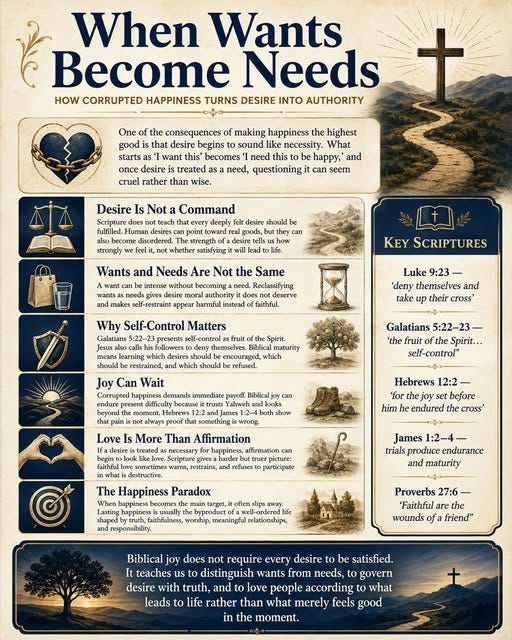
When Love Becomes Affirmation
The confusion between wants and needs eventually changes how love is understood. If someone believes a particular desire is necessary for happiness, then affirmation of that desire can begin to seem synonymous with love. Disagreement becomes rejection, boundaries become oppression, and attempts to warn someone about consequences can be interpreted as attacks on that person’s wellbeing.
Parents recognize the flaw in this reasoning when dealing with children because loving parents routinely refuse things their children sincerely believe they need. A child may experience the refusal as unfair or even cruel, while the parent understands consequences that the child cannot yet evaluate. Adulthood brings greater freedom and responsibility, but it does not eliminate the human capacity to mistake powerful wants for genuine needs.
Proverbs 27:6 describes the wounds of a friend as faithful because biblical love is concerned with the actual good of another person, not merely with protecting that person from uncomfortable feelings. Sometimes love encourages and celebrates, sometimes it comforts, and sometimes it warns because a person is moving toward consequences that present happiness has made difficult to see. None of those responses can be evaluated solely by whether they produce an immediately pleasant emotional reaction.
The Failure of Chasing Happiness
Making happiness the primary goal also creates a practical problem: the pursuit often undermines the thing being pursued. When people constantly evaluate relationships, work, faith, and ordinary life according to how happy those things make them feel, normal disappointment begins to look like evidence that something must be changed. Commitments that once provided stability can become disposable when they no longer produce the emotional return that was expected.
C. S. Lewis described a related principle when he argued that “second things” are often lost when they are treated as “first things.” Happiness frequently works this way because it grows naturally from goods such as love, friendship, meaningful work, gratitude, faithfulness, worship, and belonging. When happiness itself becomes the target, those underlying goods can be sacrificed in an attempt to recover the feeling they once produced.
Biblical joy avoids that trap because its attention is directed beyond the constant measurement of the self. A person can pursue Yahweh, love another person faithfully, fulfill a responsibility, and endure a difficult season without continually asking whether each moment feels sufficiently fulfilling. Happiness can still arise within that life, but it is received within a larger understanding of what makes life good.
Conclusion
Wanting something strongly does not make it a need, and calling something necessary for happiness does not settle whether pursuing it is wise or good. Scripture assumes that human desires require discernment because they can point toward genuine goods while also seeking those goods in disordered ways. Self-control, self-denial, patience, and endurance all depend upon the ability to distinguish between what we feel compelled to pursue and what actually contributes to human flourishing.
Love therefore cannot be reduced to helping people obtain whatever they believe will make them happy. Sometimes the loving response is affirmation, while at other times it involves warning, restraint, patience, or refusing to participate in a destructive choice. Biblical joy makes room for those difficult responses because it does not require immediate satisfaction to prove that something is good, allowing desire and happiness to remain important parts of human life without allowing either to govern everything else.
Discussion Questions
Why is it dangerous to treat the intensity of a desire as proof that the thing desired is actually a need?
How do self-control and self-denial challenge the idea that every deeply felt desire should be fulfilled?
What do Hebrews 12:2 and James 1:2–4 teach about the difference between immediate happiness and long-term joy?
When can affirmation become enabling rather than genuine love, and how does Proverbs 27:6 help us think about that distinction?
Why can making happiness the primary goal of life actually make lasting happiness more difficult to achieve?
Want to Know More?
Dallas Willard, Renovation of the Heart: Putting On the Character of Christ
Willard examines how Christian transformation reaches thoughts, feelings, choices, habits, and desires rather than merely changing outward behavior. It is especially useful for understanding why discipleship requires the formation of desire rather than simply treating whatever we strongly want as authoritative.James K. A. Smith, You Are What You Love: The Spiritual Power of Habit
Smith explores how our desires and loves are shaped by habits, worship, and the surrounding culture. His emphasis on rightly ordering what we love directly addresses the assumption that deeply felt desires necessarily reveal what is good for us.Timothy Keller, Counterfeit Gods: The Empty Promises of Money, Sex, and Power, and the Only Hope That Matters
Keller examines how legitimate human goods can become destructive when they are elevated into ultimate things. His discussion of idolatry provides a useful framework for understanding how desires for happiness, security, relationships, success, and approval can begin governing a person’s life.Richard J. Foster, Celebration of Discipline: The Path to Spiritual Growth
Foster surveys practices such as fasting, simplicity, solitude, service, and worship that train Christians not to be ruled by immediate appetites. The book provides a practical complement to the biblical emphasis on self-control, self-denial, and learning to subordinate desires to faithfulness.Augustine of Hippo, Confessions
Augustine’s account of his own restless desires remains one of Christianity’s classic examinations of the human tendency to seek fulfillment in created things rather than the Creator. His reflections on appetite, ambition, sexuality, and conversion are particularly relevant to understanding the difference between obtaining what we want and becoming rightly ordered toward God.