
“Aliens,” Interdimensional Beings, and the Repackaging of Genesis 6

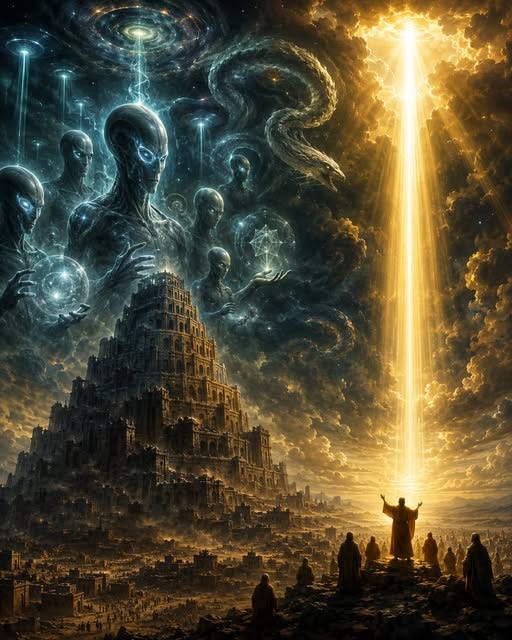
If the world ever receives a grand “disclosure” claiming that humanity was created or guided by interdimensional beings, that Yahweh is not real, and that the Bible is only a primitive misunderstanding of advanced entities, Christians should not be shocked. That story would not be new. It would be one more version of the oldest religious deception in human history: created beings presenting themselves as humanity’s makers, teachers, liberators, and rightful rulers.
The modern version may use the language of extraterrestrials, dimensions, genetic engineering, ancient technology, higher consciousness, or cosmic evolution. The ancient version used the language of gods, watchers, apkallu, divine kings, heavenly knowledge, and forbidden wisdom. The costume changes. The lie does not. The core claim remains the same: Yahweh is not the Creator and King, humanity does not owe Him worship, and salvation comes through secret knowledge delivered by beings who stand between heaven and earth.
That is why Christians should not treat every “alien disclosure” claim as harmless science fiction. The issue is not whether there are strange phenomena, whether governments hide information, or whether people have seen things they cannot explain. The issue is the theology that often rides on the back of these claims. When the message becomes “they made us,” “they seeded religion,” “Yahweh was one of them,” or “the Bible is a distorted memory of alien intervention,” we are no longer dealing with curiosity about the skies. We are dealing with a direct attack on creation, revelation, worship, and the identity of God.
Genesis 6 and the Pattern of Forbidden Mediation
Genesis 6 introduces one of the strangest and most important episodes in the Bible. The “sons of God” take human women, produce the Nephilim, and corrupt the human world. The passage is short, but it opens a door into a larger supernatural rebellion. This was not merely human sin getting worse. It was a boundary violation between heavenly beings and humanity. The created order was being invaded, hybridized, and distorted by rebellious powers.
Second Temple Jewish texts understood this episode as more than sexual rebellion. In 1 Enoch, the Watchers descend, take wives, produce giants, and teach humanity forbidden knowledge: weapons, sorcery, cosmetics, astrology, enchantments, and other arts that accelerate violence and corruption. Jubilees also connects the post-flood demonic problem to the spirits of the dead giants. These texts are not Scripture, but they show how ancient Jews read Genesis 6: rebellious heavenly beings corrupted humanity by presenting themselves as teachers and benefactors.
That matters because this is exactly the pattern modern “ancient alien” religion repeats. The claim is that higher beings descended, altered humanity, taught civilization, gave us advanced knowledge, and became remembered as gods. Genesis 6 tells the biblical version from Yahweh’s side: these were not humanity’s creators or saviors. They were rebels. They did not elevate mankind. They degraded it. They did not bring enlightenment. They helped fill the earth with violence.
The Ancient World Already Knew This Story
The idea of heavenly or semi-divine beings bringing civilization to humanity appears across the ancient world. Mesopotamian traditions speak of apkallu, semi-divine sages associated with the pre-flood world, who brought knowledge and culture to kings and cities. Other pagan traditions preserve memories of a primeval golden age, divine-human mingling, giant rulers, and civilization descending from the gods. These stories often present the beings as culture heroes.
The Bible reverses that praise. Genesis does not deny that supernatural beings interfered with humanity. It denies that their interference was good. Scripture does not portray these beings as noble helpers who brought mankind into enlightenment. It portrays their intrusion as rebellion against Yahweh, corruption of creation, and a major reason for the flood judgment.
This is one of the reasons Genesis 6 functions as a polemic. The pagan world celebrated divine-human mingling as the origin of greatness. Genesis exposes it as corruption. The pagan world remembered mighty men, heroes of old, and semi-divine rulers as signs of a glorious age. Genesis places them in a world so violent and ruined that Yahweh brings judgment. The Bible is not embarrassed by the supernatural background behind ancient civilization. It confronts it head-on and tells us what it really was.
Babel and the Nations Continue the Rebellion
The Tower of Babel continues the pattern. Humanity gathers in rebellion, builds a city and tower, and seeks to make a name for itself. In the ancient world, a tower like this was not merely a tall building. It was an artificial mountain of assembly, a ritual structure meant to connect heaven and earth. Babel was an attempt to create controlled access to the divine realm on human terms.
Genesis 6 shows heavenly beings crossing the boundary downward in rebellion. Babel shows humanity trying to cross the boundary upward in rebellion. Both reject Yahweh’s ordering of heaven and earth. Both attempt to seize divine access outside His authority. Both result in judgment.
Deuteronomy 32 then shows the next stage. Yahweh divides the nations and allots them according to the sons of God, while keeping Israel as His own inheritance. The tragedy of the nations is not that they were never spiritual. The tragedy is that they came under the administration of lesser heavenly beings who eventually accepted worship, distorted truth, and ruled unjustly. Psalm 82 announces their doom: they will die like men because they ruled the nations wickedly.
That is the biblical map behind the alien deception. The nations were not formed in a spiritually neutral world. They were formed in the shadow of Babel, under rebellious powers, surrounded by counterfeit divine claims. The modern claim that “the gods were actually interdimensional beings” does not disprove the Bible. It accidentally lands near the biblical category and then interprets it through rebellion.
“They Created Us” Is the Old Serpent Lie
The claim that interdimensional beings created humanity is not merely wrong. It is a theological replacement of Genesis 1. Scripture begins with Yahweh as the Creator of heaven and earth. Humanity is made in His image. Human dignity comes from being Yahweh’s imagers, not from being engineered livestock, cosmic experiments, or biological containers for higher beings.
The serpent’s lie in Eden was not simply “disobey a rule.” It was an assault on Yahweh’s goodness, authority, and truthfulness. The serpent suggested that God was withholding something and that humanity could achieve godlike status by seizing forbidden wisdom. Genesis 3 and Genesis 6 belong together because both involve illicit access to divine knowledge. Eden shows humanity tempted to grasp wisdom apart from Yahweh. Genesis 6 shows rebellious heavenly beings corrupting humanity with forbidden knowledge.
Modern alien religion repeats that same structure. It says humanity must awaken to hidden knowledge. It says the Bible is a primitive cover story. It says our true origin lies not in Yahweh’s creative act, but in contact with superior beings. It says salvation comes by accepting the message of these beings and moving beyond traditional faith. That is not a scientific claim wearing religious clothing. It is an ancient religious lie wearing scientific clothing.
If Aliens Were Real, Christianity Would Not Collapse
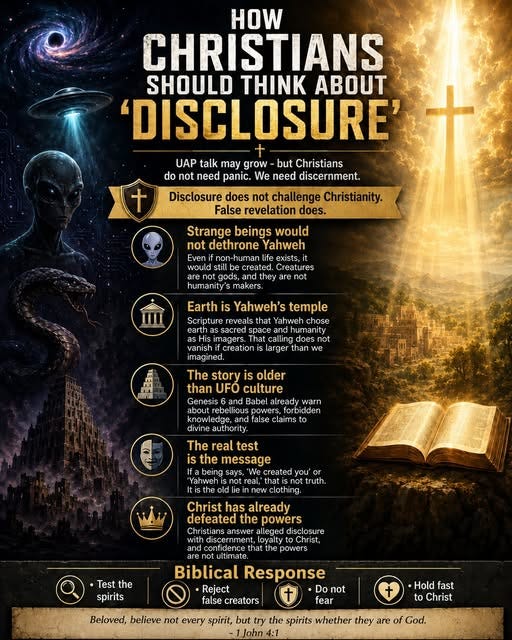
Christians should be careful not to build the argument in the wrong place. The existence of non-human biological life somewhere in creation would not disprove Christianity. Scripture teaches that Yahweh created the heavens and the earth, the visible and the invisible, thrones, dominions, rulers, authorities, and everything else that exists. If there are creatures elsewhere in the created order, they would still be creatures. They would not be gods. They would not be humanity’s creators. They would not stand above Yahweh. They would simply be another part of creation.
The Bible never says that earth contains the only possible embodied creatures God could make. What it does reveal is that Yahweh chose to make earth His temple and humanity His imagers within that temple. Genesis presents creation as ordered sacred space, with Eden functioning as the Holy of Holies and mankind placed there to image Yahweh’s rule into the world. That doctrine would not be overturned by discovering other life any more than it was overturned by discovering new continents, new peoples, microscopic organisms, or distant galaxies. The size and strangeness of creation do not shrink God. They magnify Him.
This is where the Christian answer becomes stronger, not weaker. If other creatures exist elsewhere, they do not erase the human vocation. Yahweh is free to create as He pleases, but He has revealed that this world is where He placed His image-bearing family and where He entered His own creation as the incarnate Son. Earth is not important because modern people imagined it was the physical center of the universe. Earth is important because Yahweh made it His temple, placed His imagers here, and chose this world as the stage on which creation, rebellion, covenant, incarnation, cross, resurrection, ascension, and new creation unfold.
The real issue is not whether “aliens” could exist. The issue is what they claim. If a non-human intelligence appeared and said, “We are creatures made by the same Creator,” that would be one kind of claim. If it said, “We created you, Yahweh is not real, Scripture is false, and you must now receive our higher revelation,” that would be another. The first would not threaten Christianity. The second would be a false gospel.
“Yahweh Is Not Real” Is the Goal of the Deception
A disclosure narrative that merely says “there are strange beings” would be one thing. A disclosure narrative that says “these beings created us and Yahweh is not real” is something else entirely. That is not neutral information. That is evangelism for rebellion.
The attack is carefully aimed. If Yahweh is not real, creation collapses into manipulation. If humanity is not made in His image, human identity becomes negotiable. If the Bible is only a distorted memory of alien contact, revelation loses authority. If Jesus is not Yahweh incarnate, the cross is no longer the defeat of the powers. If resurrection is replaced with ascension into a higher frequency or cosmic consciousness, salvation becomes pagan theosis without the Creator.
This is why the “Yahweh was just one of the beings” claim matters so much. It does not merely add aliens to the biblical story. It dethrones the God of the Bible and places Him inside the created order. That is exactly what paganism always does. Pagan religion does not usually deny spiritual beings. It denies the absolute uniqueness of Yahweh. It reduces Him to one being among many, one tribal deity among other gods, one mask among many names, or one member of a larger cosmic hierarchy.
Scripture will not allow that. Yahweh is not one of the beings inside the system. He created the system. The sons of God are real, but they are created. The heavenly host is real, but it is not ultimate. The gods of the nations are real spiritual powers, but they are not Yahweh. The divine council exists, but it does not place Yahweh inside a pantheon of equals. He presides over it as Creator, Judge, and King.
Interdimensional Language Does Not Change the Test
Calling these beings “interdimensional” does not make them less spiritual. It may simply be a modern way of describing beings who do not operate within ordinary human limitations. Ancient people used the language of heaven, underworld, gods, spirits, watchers, angels, demons, and divine council. Modern people often prefer dimensions, frequencies, portals, non-human intelligence, and higher planes. The vocabulary changes because cultures change.
But Christians should evaluate the message, not just the manifestation. If the beings deny Yahweh, undermine Christ, offer forbidden knowledge, encourage contact rituals, redefine humanity, and demand trust, then the category is already clear. Scripture warns about deceptive spirits, lying signs, false teachers, and supernatural powers that oppose the knowledge of God. Paul says that even if an angel from heaven preached another gospel, that messenger would be under a curse. The problem is not whether the messenger is impressive. The problem is whether the message is true.
That is why “they are too advanced to be demons” is a weak argument. In the biblical worldview, demons are not cartoon monsters with pitchforks. They are disembodied, intelligent, deceptive, and hostile to Yahweh’s purposes. Rebellious heavenly beings and demonic powers do not need to look primitive. They can appear wise, ancient, technological, enlightened, or benevolent. Deception works best when it looks like revelation.
Ancient Aliens Is Paganism with Better Graphics
The ancient aliens movement often claims to demystify religion, but it usually does the opposite. It replaces Yahweh with a technological pantheon. It keeps gods, creators, heavenly descent, forbidden knowledge, temples, priesthoods, chosen bloodlines, and apocalyptic revelation, but it renames them as aliens, engineers, star beings, genetic programs, energy grids, and disclosure.
That is not the death of religion. It is the recycling of pagan religion through modern categories. Instead of Baal, Enki, Marduk, or the Watchers, the new story gives us non-human intelligences. Instead of temples and ziggurats, it gives us portals and star gates. Instead of forbidden heavenly wisdom, it gives us suppressed technology and secret cosmic knowledge. Instead of salvation through Yahweh’s covenant and Christ’s resurrection, it gives us awakening, ascension, and reunion with our alleged makers.
The irony is that this worldview often mocks Christianity as myth while swallowing myth whole. It rejects Genesis because “talking serpents and sons of God sound primitive,” but then accepts a story where higher beings descended from the heavens, engineered mankind, guided civilization, and hid the truth through secret orders. The issue was never that the supernatural was too hard to believe. The issue was always which supernatural story people wanted to believe.
Christ Exposes and Defeats the Powers
The Christian answer to this deception is not fear. It is Christ. The New Testament does not present Jesus as one religious teacher among many. It presents Him as Yahweh embodied, the Creator entering His own creation, the Son who reveals the Father, the King who defeats the powers, and the risen Lord who receives authority over every name and every throne.
The cross was not merely a human execution. It was the decisive defeat of the rulers and authorities. Paul says Christ disarmed the powers and put them to open shame. The resurrection declares that death, demons, rebellious gods, and every counterfeit authority have already lost. The ascension announces that Jesus has been enthroned above every ruler, authority, power, dominion, and name that is named.
That means Christians do not need to panic if the world starts preaching a cosmic counterfeit. The powers have always lied. They lied through idols. They lied through pagan kings. They lied through forbidden knowledge. They lied through false prophets. They lied through mystery religions. They lied through Gnostic systems. They lied through occult spirituality. If necessary, they can lie through “disclosure” too.
But their sentence has already been announced. Psalm 82 says the corrupt gods will die like men. Colossians says Christ has disarmed the powers. Revelation says the Dragon and his kingdom will be judged. The end of the story is not humanity bowing before its supposed alien makers. The end of the story is every knee bowing and every tongue confessing that Jesus Christ is Lord.
How Christians Should Respond
Christians should avoid two opposite errors. The first error is gullibility. We should not accept every strange claim, blurry video, government statement, or alleged channeling as truth. The second error is materialistic dismissal. We should not assume that because something is strange, it must be fake, psychological, or purely technological. The biblical worldview gives us a better category: the world is supernatural, but not every supernatural message is from God.
The test is theological. Does the message confess the true God revealed in Scripture? Does it honor Jesus Christ as Lord? Does it preserve Yahweh as Creator and King? Does it uphold humanity as made in God’s image? Does it lead to repentance, worship, holiness, and truth? Or does it offer hidden knowledge, undermine Scripture, relativize Christ, and invite humanity to trust created beings instead of the Creator?
That is where the modern alien deception exposes itself. The moment the message says “Yahweh is not real,” it has crossed from speculation into rebellion. The moment it says “they created us,” it has attacked the image of God. The moment it says “religion was seeded to control you,” it has positioned itself as a rival revelation. The moment it says “these beings are our makers,” it has returned to the old lie of the gods.
Conclusion
A future “disclosure” claiming that interdimensional beings created humanity and that Yahweh is not real would not be a new revelation. It would be the same counterfeit story told since the days before the flood: rebellious beings descending, offering knowledge, corrupting humanity, claiming authority, and redirecting worship away from the Creator.
Genesis 6 already prepared us for this. Babel already prepared us for this. Deuteronomy 32 and Psalm 82 already prepared us for this. The New Testament already prepared us for deceptive powers, false gospels, lying signs, and spiritual rulers who oppose Christ.
Christians do not need to be naïve, and we do not need to be afraid. We need discernment. The Bible’s supernatural worldview is not threatened by claims of non-human intelligence. It already has categories for heavenly beings, rebellious powers, demons, signs, wonders, deception, and cosmic conflict. What it will never allow is the demotion of Yahweh into one being among many or the replacement of Christ with a counterfeit cosmic savior.
The old lie says humanity needs to awaken to its true creators. The gospel says humanity needs to return to its true Creator. The old lie says hidden beings made us and now return to guide us. The gospel says Yahweh made us, Christ redeemed us, and the Spirit seals us until the day when every counterfeit power is finally judged.
Discussion Questions
Why is it important to distinguish between the existence of possible non-human life and the theological claims attached to that life?
How does Genesis 6 help us understand the pattern of rebellious beings presenting themselves as teachers, benefactors, or sources of forbidden knowledge?
Why would a claim like “these beings created humanity” directly attack the biblical doctrine that humans are made in the image of Yahweh?
How does Babel show the same impulse as Genesis 6, but from the human side - the attempt to access the divine realm on rebellious terms?
Why does 1 John 4:1 give Christians a better response to “disclosure” claims than either panic or blind acceptance?
Want To Know More?
Reversing Hermon: Enoch, the Watchers, and the Forgotten Mission of Jesus Christ by Michael S. Heise: This book is the most direct resource for the Genesis 6 side of the lesson. Heiser focuses on the Watchers, the Nephilim, 1 Enoch, Second Temple Jewish interpretation, and how the rebellion of Genesis 6 forms part of the background for the mission of Christ. It helps explain why stories about descending heavenly beings, forbidden knowledge, and corrupted humanity are not new.
The Lost World of Genesis One: Ancient Cosmology and the Origins Debate by John H. Walton: Walton’s work helps readers understand Genesis 1 in its ancient :Near Eastern context, especially the idea of creation as ordered sacred space rather than merely the manufacture of physical material. This supports the lesson’s claim that Yahweh chose earth as His temple and humanity as His imagers within that temple.
The Temple and the Church’s Mission: A Biblical Theology of the Dwelling Place of God by G. K. Beale: Beale traces the Bible’s temple theme from Eden to the tabernacle, temple, Christ, the church, and the new creation. This is helpful for showing why earth matters theologically, not because it must be the physical center of the universe, but because Yahweh chose it as the place where His image-bearing family would dwell and where redemption would unfold.
Against the Gods: The Polemical Theology of the Old Testament by John D. Currid: Currid’s book is useful for understanding how the Old Testament often confronts and corrects pagan stories from the surrounding nations. That makes it valuable for this lesson because Genesis 6, Babel, creation, and the gods of the nations should not be read as Israel borrowing pagan myths. Scripture often takes the claims of the pagan world and reverses them under Yahweh’s authority.
The Bible Among the Myths: Unique Revelation or Just Ancient Literature? by John N. Oswalt: Oswalt helps explain why the Bible is not simply one more ancient myth dressed in Israelite language. He contrasts the biblical worldview with the mythological worldview of the ancient Near East, especially on creation, divine authority, morality, and history. This strengthens the lesson’s point that modern “ancient alien” religion is not a neutral discovery - it is often pagan mythology repackaged in technological language.